
Add Date: 2026/9/8 Views: 1
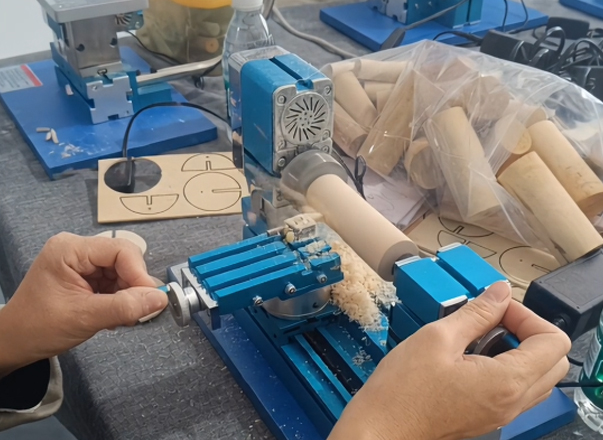
In primary and secondary school campuses, an increasing number of makerspaces are becoming the first window through which young people touch the engineering world. There is no rigid boundary of the traditional classroom; instead, there are open workbenches filled with tools, small processing equipment that can be started at any time, and a group of young people who, driven by curiosity, are eager to turn their ideas into physical objects.
As a creative practice platform for the general public, the core value of a makerspace lies in providing learners of different levels with a low‑threshold, high‑safety making environment, so that engineering enlightenment no longer stays in the formulas and schematic diagrams of textbooks.
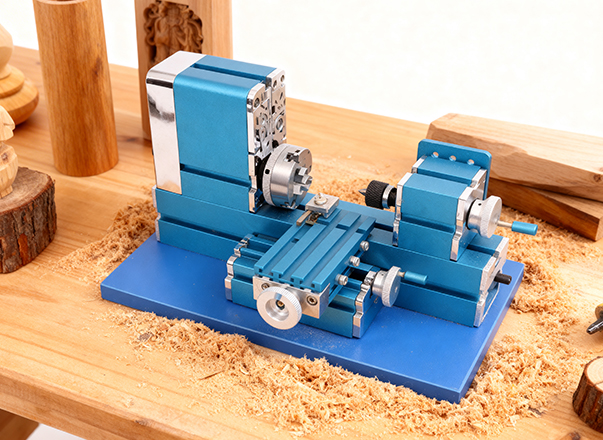
Even more significant is the introduction of miniature safety machine tools for students. These miniature machine tools are scaled‑down prototypes of industrial‑grade machines, featuring small size, light weight, little floor space, and the ability to process a wide range of materials. An advanced kit can be flexibly configured into 6 or even 8 different types of machine tools, including metal saws, metal lathes, metal milling machines, metal drilling machines, and metal grinders. This flexibility allows students to experience multiple processing methods within limited space and budget.
W103MB Metal Lathe
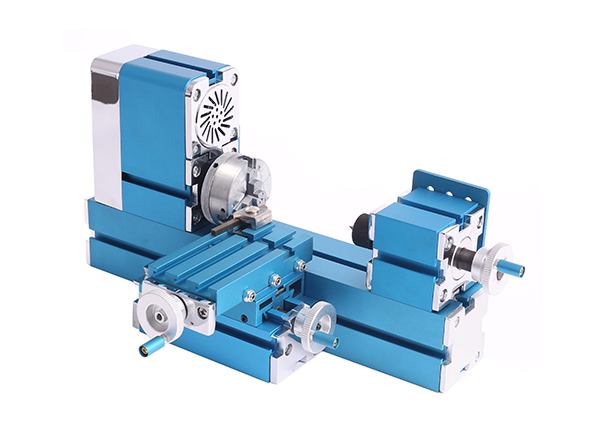
Features:
The lathe operates on safe voltage power and has a plastic‑free body, which greatly improves stability and durability. With X‑ and Z‑axis handle controls for feed, it can turn various cylindrical shapes, such as Roman columns, vases, and wine glasses. It is mainly used for precision machining of precious metals, copper, aluminum, and other metal workpieces.
Technical Specifications:
Motor speed: 20,000 r/min ±15%
Spindle speed: 3,000 r/min ±15%
Voltage/Power: 100V‑240V, 24W (optional 36W, 60W)
Spindle bore: 8 mm
Center distance: 110 mm (expandable to 330 mm with optional extended bed)
Center height: 25 mm (expandable to 45 mm with optional extended bed)
Maximum clamping diameter: 13 mm with external jaws / 45 mm with internal jaws
Machinable materials: wood, soft metals (aluminum, copper), acrylic, plastics, etc.
Product dimensions: 278 x 183 x 150 mm
Packaging dimensions: 330 x 205 x 241 mm
Applications:
Campus makerspaces, labor and technology classes, metalworking and woodworking, high school general technology courses, comprehensive practice programs, and other on‑campus and off‑campus educational settings, as well as personal DIY projects.
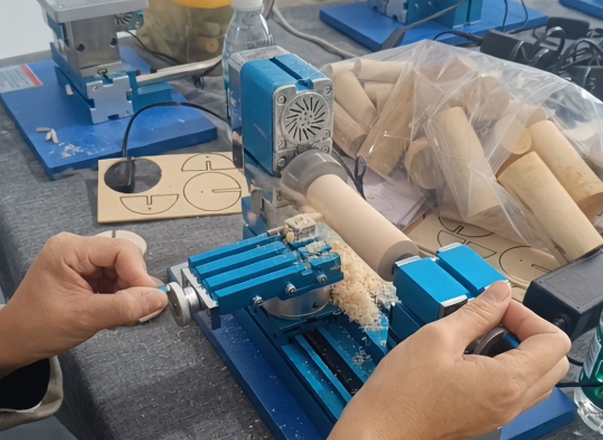
In the actual operation of makerspaces, students act both as designers and engineers. They first plan and design through thinking, and then use the miniature machine tools to bring their ideas to life. From simple puzzles and small chairs to complex model assemblies, each piece embodies creativity and effort. In the makerspace, a small woodworking saw is not just a cutting device; it is a miniature laboratory for technology and engineering education.
By operating these tools, students upgrade from simply “doing by hand” to “thinking with the mind, making with the hands, and comprehending with the heart.” In the reciprocating sound of the saw blade, they understand the mysteries of mechanical transmission; in each precise cut, they appreciate the importance of engineering accuracy.
Safe and reliable student‑oriented machine tools, thoughtfully designed teaching machines, and feature‑rich makerspace equipment are no longer unattainable industrial devices—they have become “teaching aids” for engineering enlightenment. They embed rigorous mechanical logic and a focused craftsmanship spirit into every tool pass and every dimensional measurement, enabling young creators to truly grasp the entry key to the age of intelligent manufacturing as they turn their ideas into reality.
Looking ahead, the construction of makerspaces in primary and secondary schools should move toward greater systematization, curriculum integration, and safety. Let every child experience the joy of creation through sawing and sanding, and nurture engineering awareness through design and making—this is not only an essential part of labor education but also the foundation for cultivating innovative talent. The engineers of the future may very well be the focused young person standing beside today’s safety machine tool.
 中文版
中文版






 Location: