
Add Date: 2026/5/26 Views: 1
Small Machining Center: The “Sharp Tool” Connecting Vocational Skills and CNC Training
Keyword:Small machining center, Desktop machining center,Small five axis machining center, Desktop teaching machining center, Manufactur factory
In the era of rapid development in smart manufacturing, CNC machining technology has become the core of modern industry. Machining centers, as high-precision, high-efficiency automated machine tools, are extending their application scope from large factories to vocational colleges, technical schools, and even maker spaces.
Traditional large machining centers, although powerful, have drawbacks such as large footprints, high investment costs, and significant safety risks, making them unsuitable for frequent operation by beginners. The emergence of desktop machining centers fills this gap perfectly – they are compact (can be placed on a lab table or dedicated desk), run on standard 220V power, and come with fully enclosed protective covers and safety door locks. They realistically simulate industrial machining processes while greatly reducing operating costs and safety hazards.
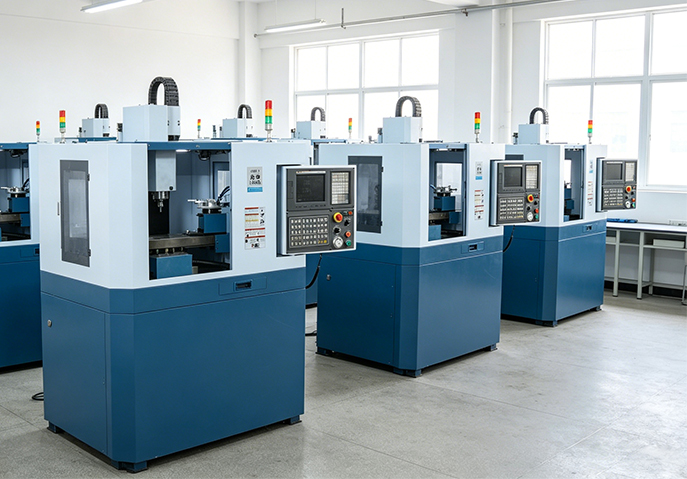
For vocational skills education, training equipment must be close to actual factory conditions. Small machining centers, despite their size, use the same control systems (e.g., FANUC, Siemens, or mainstream domestic CNC systems), programming commands (G-code/M-code), and tool magazine management as full-sized production equipment. Students can accomplish the following on a desktop machine:
CNC program verification: Manually written programs or CAM post-processed programs can be run directly on the machine to instantly observe toolpaths and collision risks.
Process parameter tuning: Hands-on setting of spindle speed, feed rate, and depth of cut to understand how different parameters affect surface quality and machining efficiency.
Tool and fixture practice: Familiarization with tool change commands, tool length compensation, workpiece coordinate system setting, and other key skills.
Through high-frequency hands-on practice with “one person per machine” or even “one machine per small group”, students transform abstract CNC theory into real muscle memory and problem-solving ability – exactly the vocational skills that enterprises value most.
XENDOLL Small CNC Machining Center VMC220
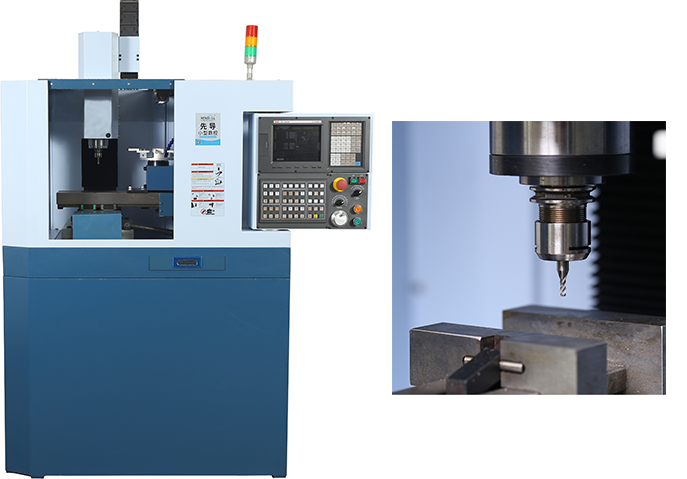
Product Features:
Operates on 220V power, small footprint, low power consumption. Combines transparent acrylic with sheet metal – improves visibility and safety while ensuring structural rigidity. Fully enclosed.
Equipped with a 4-station automatic tool changer (upgradable to 6 stations), requiring 0.6Mpa air pressure.
High-precision industrial-grade spindle with ISO20 taper, spindle speed 300–24,000 rpm.
Technical Specifications:
Parameter Value
Tool clamping diameter 2–13 mm
Work table 400 × 140 mm
X-axis travel 220 mm
Y-axis travel 120 mm
Z-axis travel 200 mm
Spindle center to column 180 mm
Spindle nose to table 200 mm
Rapid traverse rate X/Y axis 6000 mm/min; Z axis 4000 mm/min
Spindle speed 300–24,000 rpm
Spindle motor power 1.5 kW
Net / Gross weight 160 / 180 kg
Machine dimensions 1359 × 930 × 1064 mm; 1359 × 930 × 1740 mm (with base)
Do not assume that small equipment is only for schools. In real factories, small machining centers also play important roles:
Rapid prototyping and small-batch production: When R&D departments need validation parts or fixtures, desktop equipment can complete the task quickly without occupying large production lines.
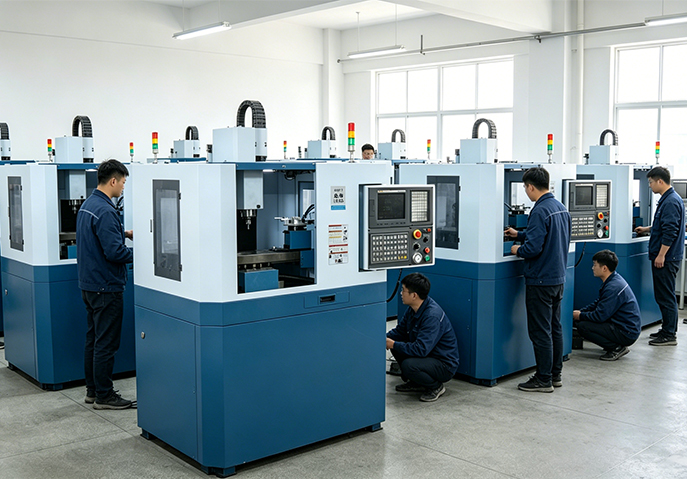
Employee skill training: New hires first learn programming and operating procedures on small machines; after passing assessments, they move to large machine tools – greatly reducing training costs and accident risks.
Spare parts and mold repair: For small copper electrodes, non-standard threads, or simple mold touch-ups, desktop machining centers offer flexible responses and reduce machine downtime.
From CNC training classrooms in vocational colleges, to skill training corners in factory workshops, to innovation spaces for university makers, small and desktop machining centers – with their high cost‑effectiveness, high safety, and excellent fit to teaching needs – are building a solid bridge between theory and practice, between classroom and factory. They not only lower the barrier to entry for CNC technology but also nurture a large number of versatile vocational talents who understand both programming and hands-on operation.
Welcome to our video link:
YouTube: Xendoll
Facebook: Xendoll
WEB:www.xendolltools.com
 中文版
中文版






 Location: